OCD, Uncertainty, Doubt, and Confidence: Why the Search for Certainty Keeps You Stuck
If you struggle with Obsessive-Compulsive Disorder (OCD), chances are you've spent countless hours trying to answer a question that feels urgent and important:
"What if?"
What if I accidentally harmed someone?
What if I made a mistake?
What if I'm a bad person?
What if my relationship isn't right?
What if I'm wrong about something important?
For people with OCD, these questions don't simply come and go. They can trigger intense anxiety, guilt, fear, and self-doubt. In response, many people find themselves checking, researching, analyzing, confessing, seeking reassurance, or mentally reviewing events in an effort to feel certain.
Unfortunately, certainty is exactly what OCD is chasing—and exactly what it can never fully obtain.
OCD Is a Disorder of Doubt
At its core, OCD thrives on uncertainty.
Everyone experiences uncertainty in life. Most people can tolerate not knowing something with complete certainty and move forward anyway. People with OCD often feel an overwhelming need to eliminate all doubt before they can feel safe, confident, or at peace.
The problem is that certainty is largely an illusion.
There is no way to be 100% certain that you locked the door correctly, won't get sick, won't make a mistake, won't offend someone, or won't have an unwanted thought tomorrow. Life simply doesn't offer that guarantee.
Yet OCD insists that certainty is possible—and that you must find it before you can relax.
This creates the familiar OCD cycle:
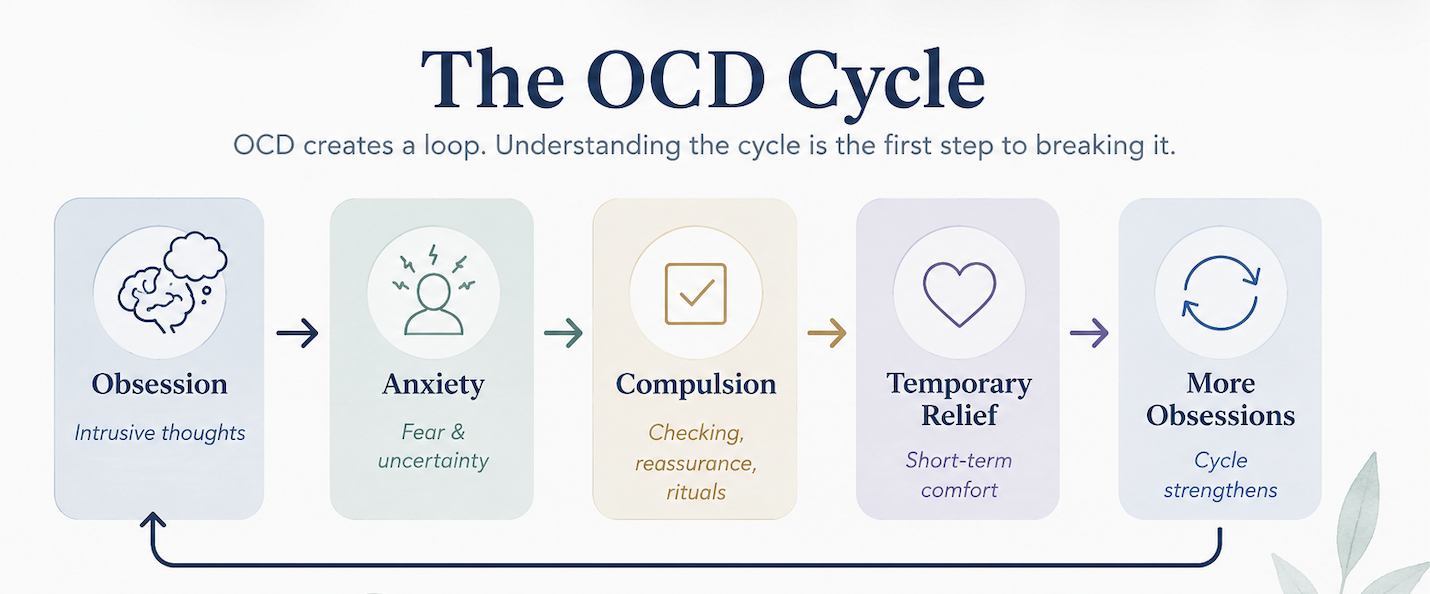
The more you seek certainty, the more important your brain concludes the threat must be.
The Biggest Misunderstanding About Uncertainty
One of the most common misconceptions in OCD treatment is the belief that accepting uncertainty means believing your worst fear is likely to happen.
Many people hear phrases such as "accept uncertainty" and think:
"So I have to accept there's a 50% chance my fear is true?"
Not at all.
Accepting uncertainty does not mean believing that catastrophe is probable. It means accepting that you cannot achieve absolute certainty about the future.
For example, someone with contamination OCD may think:
"What if there are dangerous germs on my hands?"
Accepting uncertainty doesn't mean believing there is a high likelihood of serious illness. It means resisting the urge to repeatedly wash, research, or seek reassurance in order to prove the fear impossible.
Similarly, someone with Harm OCD may wonder:
"What if I lose control and hurt someone?"
Accepting uncertainty doesn't mean agreeing that they are dangerous. It means acknowledging that no one can obtain perfect certainty about every future event and choosing not to engage in compulsive attempts to eliminate the doubt.
The goal is not to calculate the odds.
The goal is to stop treating uncertainty as an emergency.
Confidence Is Not the Same as Certainty
Many people with OCD believe they need certainty before they can feel confident.
In reality, healthy confidence works very differently.
Confidence is not knowing with 100% certainty that everything will be okay.
Confidence is trusting yourself to handle life despite uncertainty.
Think about driving a car. Most people drive confidently every day despite knowing there is always some level of risk. They don't spend hours calculating every possible outcome before getting behind the wheel.
They accept uncertainty and move forward.
The same principle applies to OCD recovery.
Recovery is not about becoming certain that your obsession is false.
Recovery is about becoming confident that you can tolerate uncertainty without performing compulsions.
Why Reassurance Doesn't Work
Many individuals with OCD seek reassurance from family members, friends, therapists, doctors, clergy, or the internet.
They ask questions such as:
"Do you think I'm a good person?"
"Are you sure I didn't do anything wrong?"
"Do you think this means something about me?"
"Would a dangerous person worry this much?"
While reassurance may temporarily reduce anxiety, the relief rarely lasts.
Soon another doubt appears.
Then another.
And another.
OCD is rarely satisfied with a single answer because the disorder isn't actually seeking information—it is seeking certainty.
Since certainty is impossible, reassurance becomes a short-term solution that unintentionally strengthens OCD over time. Research and clinical experience consistently show that reassurance seeking functions as a compulsion and keeps the cycle alive. Exposure and Response Prevention (ERP) treatment helps individuals learn how to resist these compulsive behaviors and tolerate uncertainty more effectively.
Exposure and Response Prevention: Learning to Live with Uncertainty
Exposure and Response Prevention (ERP) is considered the gold-standard treatment for OCD.
Rather than helping clients disprove their fears, ERP helps them develop a new relationship with uncertainty.
During treatment, individuals gradually face situations that trigger obsessions while resisting compulsions such as checking, reassurance seeking, researching, confessing, avoidance, or mental reviewing.
Over time, the brain learns a powerful lesson:
Uncertainty is uncomfortable, but it is not dangerous.
As people stop engaging in compulsions, anxiety naturally decreases and confidence grows.
Not because certainty was achieved.
Because the need for certainty begins to lose its power.
You Are Already Better at Uncertainty Than You Think
Many people with OCD believe they are uniquely bad at handling uncertainty.
The truth is that they tolerate uncertainty all day long.
You don't know for certain that your car won't break down tomorrow.
You don't know for certain that you'll never get sick.
You don't know for certain that every decision you make will be the right one.
Yet you continue living your life.
The challenge is not that people with OCD cannot tolerate uncertainty.
The challenge is that OCD convinces them that certain topics are exceptions—that these particular fears must be resolved before they can move forward.
Effective OCD therapy helps individuals recognize that these obsessions are not exceptions at all. They are simply more examples of life's unavoidable uncertainty.
Recovery Means Choosing Confidence Over Certainty
If there is one lesson that OCD recovery teaches, it is this:
You do not need certainty to live a meaningful life.
You do not need certainty to be a good parent, partner, student, employee, or friend.
You do not need certainty to make decisions.
And you do not need certainty to recover from OCD.
The path forward is not found by finally answering every "what if."
The path forward is learning to say:
"Maybe. Maybe not. I'm willing to live my life anyway."
That is where true confidence begins.
OCD Treatment at Fairfield Counseling Center
At Fairfield Counseling Center, we specialize in evidence-based treatment for OCD and anxiety disorders. Our therapists are trained in Exposure and Response Prevention (ERP), Cognitive Behavioral Therapy (CBT), and other proven approaches that help individuals break free from the cycle of obsessions, compulsions, reassurance seeking, and self-doubt.
Whether you are struggling with Harm OCD, Relationship OCD (ROCD), Contamination OCD, Scrupulosity, Health OCD, Pure O, or another OCD subtype, recovery is possible.
You do not have to keep chasing certainty.
Contact Fairfield Counseling Center today to schedule a consultation and learn how specialized OCD treatment can help you regain confidence, tolerate uncertainty, and get back to living the life you want.