
When “Just One Task” Turns Into Ten: Understanding OCD Task Chaining and How to Break the Cycle
If you’ve ever found yourself unable to start a simple task because it suddenly feels tied to a dozen other things, you’re not alone. As an OCD therapist, I often hear clients describe a frustrating pattern where one small responsibility snowballs into an overwhelming chain of “must-do” actions. This experience is commonly known as task chaining or snowballing, and it’s a hallmark feature of obsessive-compulsive patterns.
Understanding how this works is a powerful first step toward finding relief through effective OCD therapy and OCD treatment.
What Is Task Chaining in OCD?
Task chaining occurs when an initial task triggers a cascade of additional “shoulds,” driven by a sense of incompleteness, discomfort, or the need for things to feel “just right.” What starts as a manageable action quickly becomes mentally unmanageable.
This pattern is often fueled by:
Perfectionism
Inflated responsibility
Fear of contamination or inefficiency
A strong internal sense that things must be done “correctly” or not at all
Why This Happens: The OCD Cycle
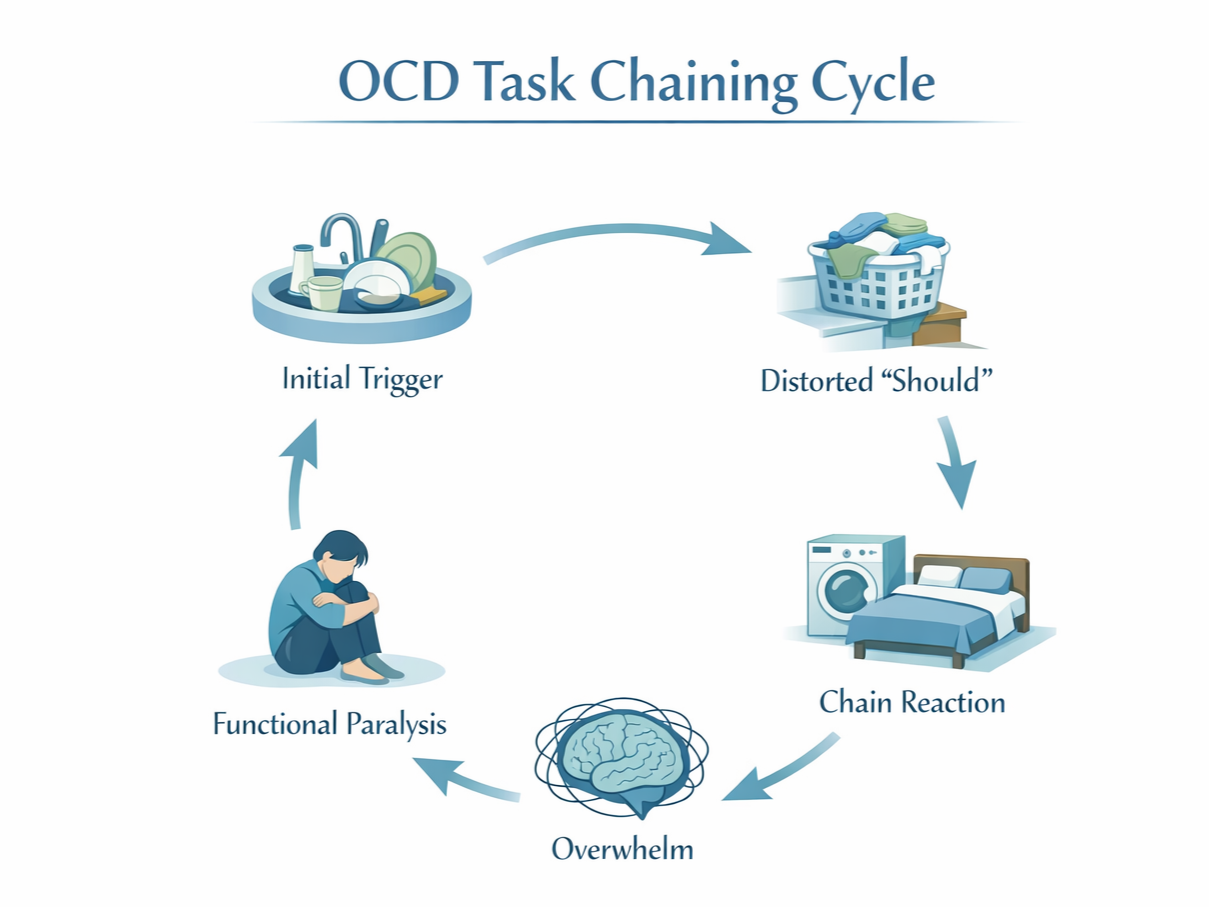
Task chaining follows a predictable OCD loop:
1. The Initial Trigger
“I need to do the dishes.”
2. The Distorted ‘Should’
“While I’m downstairs, I should bring the laundry.”
3. The Chain Reaction
“If I’m doing laundry, I should wash the bedding too—to be efficient or prevent contamination.”
4. The Overwhelm
Your brain attaches a long “tail” of tasks to the original one, making the whole process feel too big to begin.
5. Functional Paralysis
You’re not avoiding tasks out of laziness—you’re stuck because your brain insists everything must be done perfectly and completely, or not at all.
This is where many people feel trapped, and it’s a key focus area in effective OCD treatment.
How OCD Therapy Helps Break the Cycle
In evidence-based OCD therapy—especially Exposure and Response Prevention (ERP) and Acceptance and Commitment Therapy (ACT)—the goal is not to complete the chain. The goal is to break it.
Here are practical strategies used in treatment:
1. Label the Pattern
Start by identifying what’s happening in real time:
“This isn’t efficiency—this is my OCD creating a chain reaction.”
This simple awareness helps you separate yourself from the OCD-driven thought process.
2. Practice “Un-Bundling” Tasks (ERP)
Choose one task and intentionally do only that task.
Example:
Go downstairs to do the dishes—and deliberately do not pick up the laundry.
You may feel anxious or uncomfortable. That’s expected. In OCD therapy, learning to tolerate that discomfort without acting on it is key to long-term change.
3. Use the One-Task Rule
Commit to completing just the original task.
When additional thoughts arise:
Acknowledge them as “sticky thoughts”
Gently return your focus to the present task (e.g., the feel of water, soap, dishes)
4. Accept “Good Enough”
OCD demands perfection. Recovery requires practicing imperfection.
Try:
Leaving a task slightly incomplete
Doing something in a less-than-ideal way
This builds tolerance and reduces OCD’s grip over time.
5. Stop Before the Tail Grows
If you notice the chain has already started, pause it where you are.
Example:
“I’m changing the bedding—but I’m not going to vacuum the mattress, even though I feel the urge.”
Managing Overwhelm and Functional Paralysis

When you feel stuck and unable to begin anything, these tools can help:
Remind Yourself: Discomfort Is Not Danger
The urgency you feel is emotional—not an actual emergency.
Take Micro-Steps
Do just 30 seconds of the first task. Starting small reduces resistance.
Delay the Compulsion
Tell yourself:
“I can do that next task—but I’ll wait 20 minutes.”
Often, the intensity of the urge decreases with time.
When to Seek OCD Treatment
If task chaining, overwhelm, or paralysis are interfering with your daily life, working with an OCD therapist trained in ERP can make a meaningful difference. ERP is considered the gold standard in OCD treatment because it directly targets the cycle that keeps you stuck.
You don’t have to keep living in a loop where simple tasks feel impossible.
Take the Next Step
If you’re ready to break free from OCD patterns and regain control of your time and energy, professional support can help you get there.
Contact Fairfield Counseling Center today to connect with a therapist specializing in OCD therapy and evidence-based OCD treatment. You deserve support that helps you move forward—one manageable step at a time.