
Understanding OCD and Rumination: How ERP Treatment Can Help
If you struggle with persistent, distressing thoughts that won’t let go, you may be experiencing Obsessive-Compulsive Disorder (OCD). One of the most misunderstood and exhausting aspects of OCD is rumination—a mental process that can quietly maintain the cycle of obsessions and anxiety.
As part of effective OCD treatment, it’s essential to understand how rumination functions as a mental compulsion and how Exposure and Response Prevention (ERP treatment) helps break this cycle.
What Is OCD?
According to the Diagnostic and Statistical Manual of Mental Disorders (5th ed.) by Diagnostic and Statistical Manual of Mental Disorders, Fifth Edition, OCD involves:
Obsessions – intrusive, unwanted thoughts, images, or urges that cause distress
Compulsions – repetitive behaviors or mental acts performed to reduce anxiety or prevent feared outcomes
While many people associate compulsions with visible behaviors (like checking or washing), compulsions are often internal. These mental compulsions can be harder to detect—but just as powerful.
Rumination is one of the most common.

What Is Rumination in OCD?
Rumination in OCD is not simply “overthinking.” It is a repetitive mental review or analysis intended to:
Figure something out with certainty
Prove or disprove a feared thought
Analyze past events for reassurance
Mentally check your feelings or intentions
Solve an unanswerable “what if?”
For example:
“What if I offended someone five years ago?” → Mentally replaying conversations for hours
“What if I don’t really love my partner?”→ Constantly analyzing your feelings
“What if I harmed someone accidentally?”→ Reviewing memories for proof
The intrusive thought (the obsession) triggers anxiety. Rumination temporarily reduces that anxiety. But because it provides short-term relief, your brain learns: “When this thought appears, I must analyze it.”
This is how rumination becomes a mental compulsion.
How Rumination Maintains the OCD Cycle
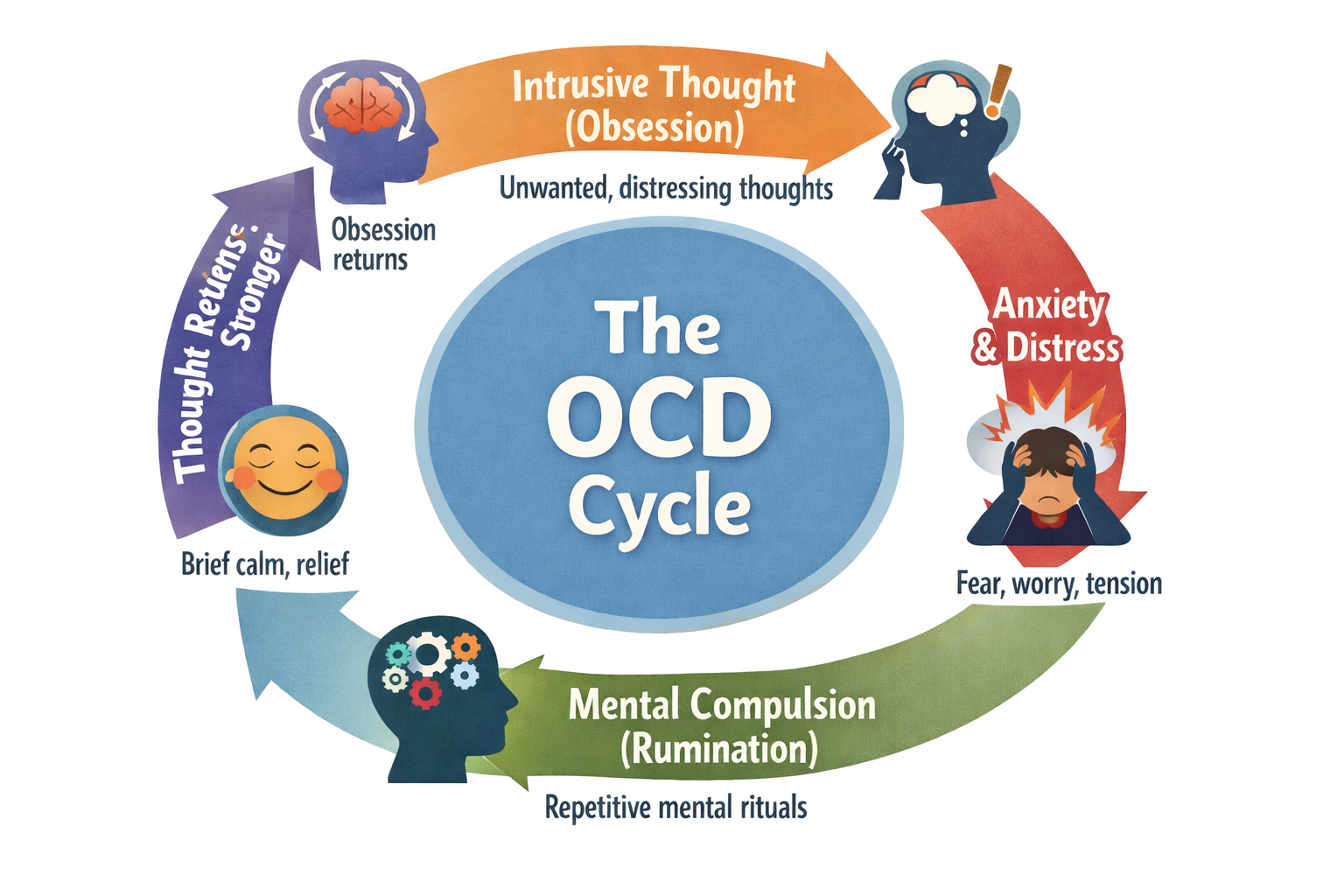
Even though rumination feels productive, it actually strengthens obsessions over time. Why?
Because the brain interprets rumination as confirmation that the thought is dangerous and important.
In effective OCD treatment, we don’t try to eliminate intrusive thoughts. Instead, we change your response to them.
ERP Treatment: The Gold Standard for OCD
Exposure and Response Prevention (ERP treatment) is the most evidence-based psychotherapy for OCD.
ERP involves two key components:
1. Exposure
You gradually and intentionally face triggers for your obsessions (situations, thoughts, images, or uncertainties).
2. Response Prevention
You resist performing compulsions—including mental compulsions like rumination.
This is crucial. Many individuals engage fully in exposures but continue ruminating afterward, unintentionally reinforcing OCD.
How to Stop Rumination in ERP Treatment
From an ERP perspective, the goal is not to “solve” the thought. It is to allow uncertainty and discomfort without engaging mentally. Here’s what that looks like in practice:
✔ Notice the Intrusive Thought
Label it:
“That’s an OCD thought.”
✔ Identify the Urge to Ruminate
“I’m feeling the urge to analyze this.”
Awareness is the first step in effective OCD treatment.
✔ Allow Uncertainty
Instead of solving the thought:
“Maybe it’s true. Maybe it’s not.”
This response may feel uncomfortable. That discomfort is the exposure.
✔ Redirect Attention Gently
Not as distraction to suppress the thought—but as a choice not to engage.
You are training your brain that intrusive thoughts are not threats requiring analysis.
Common Myths About Rumination

“If I just think about it enough, I’ll feel better.”
In OCD, thinking more rarely brings lasting relief. It strengthens obsessions.
“But this feels important.”
OCD specializes in making thoughts feel urgent and morally significant.
“I can’t control my thoughts.”
Correct. You cannot control intrusive thoughts.
But you can learn to change your response to them.
The Emotional Challenge of Letting Go
Stopping rumination can initially increase anxiety. Many patients describe it as:
Feeling irresponsible
Feeling careless
Feeling morally wrong
Feeling like something terrible will happen
This reaction is expected in ERP treatment. Anxiety rises before it falls. With repetition, your brain recalibrates.
Over time:
Intrusive thoughts become less sticky
Anxiety peaks lower and resolves faster
The urge to ruminate weakens
When to Seek Professional OCD Treatment
If you find that:
You spend hours mentally reviewing events
You struggle with “what if” loops
You seek constant internal reassurance
Your thoughts interfere with work or relationships
You may benefit from specialized OCD treatment with ERP.
Not all therapy approaches are effective for OCD. Traditional talk therapy that focuses on analyzing thoughts can unintentionally increase rumination. Working with a clinician trained specifically in Exposure and Response Prevention (ERP treatment) is critical.
You Are Not Your Thoughts
Intrusive thoughts are a universal human experience. In OCD, the problem isn’t the thought—it’s the meaning assigned to it and the compulsive response that follows.
Recovery doesn’t mean eliminating obsessions. It means learning that you can tolerate uncertainty without engaging in compulsions—mental or physical.
Freedom comes not from solving every doubt, but from no longer needing to.
Ready to Begin OCD Treatment?
If rumination and intrusive thoughts are consuming your time and energy, specialized OCD treatment using ERP can help you break the cycle.
Reach out today to Fairfield Counseling Center to schedule a consultation and learn how Exposure and Response Prevention can help you reclaim your attention, your peace of mind, and your life.