
High-Functioning Anxiety: When Success Comes With a Constant Inner Struggle
You’re getting things done. You’re dependable, responsible, successful, and often the person others turn to when they need help.
From the outside, everything may look fine.
But internally, you may feel like you’re constantly running on high alert.
You replay conversations after they happen. You worry about making mistakes. You set impossibly high standards for yourself and have a hard time relaxing—even when there’s nothing urgent to do. Your mind is always planning, anticipating, analyzing, or preparing for what could go wrong.
This can be high-functioning anxiety: a pattern in which anxiety may be hidden behind achievement, productivity, perfectionism, and an intense need to stay in control.
Because you’re functioning well on the outside, it can be difficult to recognize just how much anxiety is actually costing you on the inside.
What Is High-Functioning Anxiety?
"High-functioning anxiety" isn't a formal clinical diagnosis. Rather, it's a term commonly used to describe people who experience significant anxiety while continuing to meet—or even exceed—their responsibilities at work, at home, and in their relationships.
You may be successful and still be struggling with anxiety.
In fact, achievement can sometimes become part of the way anxiety is managed.
You work harder because you're afraid of falling behind. You over-prepare because you don't want to make a mistake. You say yes because you're worried about disappointing someone. You stay busy because slowing down gives your anxious thoughts more room to surface.
Eventually, productivity can become less about what you genuinely want and more about avoiding the discomfort of uncertainty, failure, criticism, or letting someone down.
Signs of High-Functioning Anxiety
High-functioning anxiety can look different from person to person, but some common patterns include:
Constant overthinking or mentally rehearsing situations
Perfectionism and fear of making mistakes
Difficulty relaxing or "turning off" your mind
Feeling guilty when you're not being productive
Excessive planning and preparation
Frequently seeking reassurance
Difficulty saying no or setting boundaries
Worrying about what other people think of you
Replaying conversations and wondering if you said the wrong thing
Feeling responsible for keeping everything under control
Difficulty delegating because you believe things won't be done correctly
Trouble sleeping because your mind won't slow down
Physical tension, restlessness, or feeling constantly "on"
Irritability or difficulty being present with the people you care about
A persistent sense that you should be doing more
You may recognize several of these patterns—or perhaps most of them.
And you may still wonder, "But isn't this just who I am?"
When Perfectionism Becomes a Coping Strategy
Perfectionism often gets praised.
Being thorough, motivated, conscientious, and ambitious can certainly be strengths. The problem arises when your standards become so rigid that you never feel like you've done enough.
With anxiety, perfectionism can become a way of trying to create certainty and prevent uncomfortable outcomes.

If I do everything perfectly, I won't be criticized.
If I anticipate every possible problem, nothing will go wrong.
If I keep everyone happy, I won't disappoint anyone.
f I work harder, maybe I won't feel like I'm falling behind.
There is always another detail to check, another possibility to consider, or another standard to meet.
As a result, even accomplishments may bring only temporary relief rather than genuine satisfaction.
The Exhaustion of Always Being "On"
One of the most difficult parts of high-functioning anxiety is that other people may not realize you're struggling.
You may hear things like:
"You seem to have it all together."
"I don't know how you manage everything."
"You're so organized."
"You're always so calm."
Meanwhile, you may feel exhausted, overwhelmed, or one unexpected problem away from unraveling.
This disconnect can make anxiety particularly lonely. You may even feel that you don't have a "good enough" reason to ask for help because you're still functioning.
But anxiety doesn't have to completely disrupt your life before it deserves attention.
You don't need to wait until you're unable to work, sleep, parent, maintain relationships, or complete everyday responsibilities before seeking anxiety treatment.
If anxiety is taking up significant mental and emotional space, it's worth addressing.
Why Anxiety Can Be So Difficult to Turn Off
Anxiety often creates a cycle of worry followed by attempts to regain control.
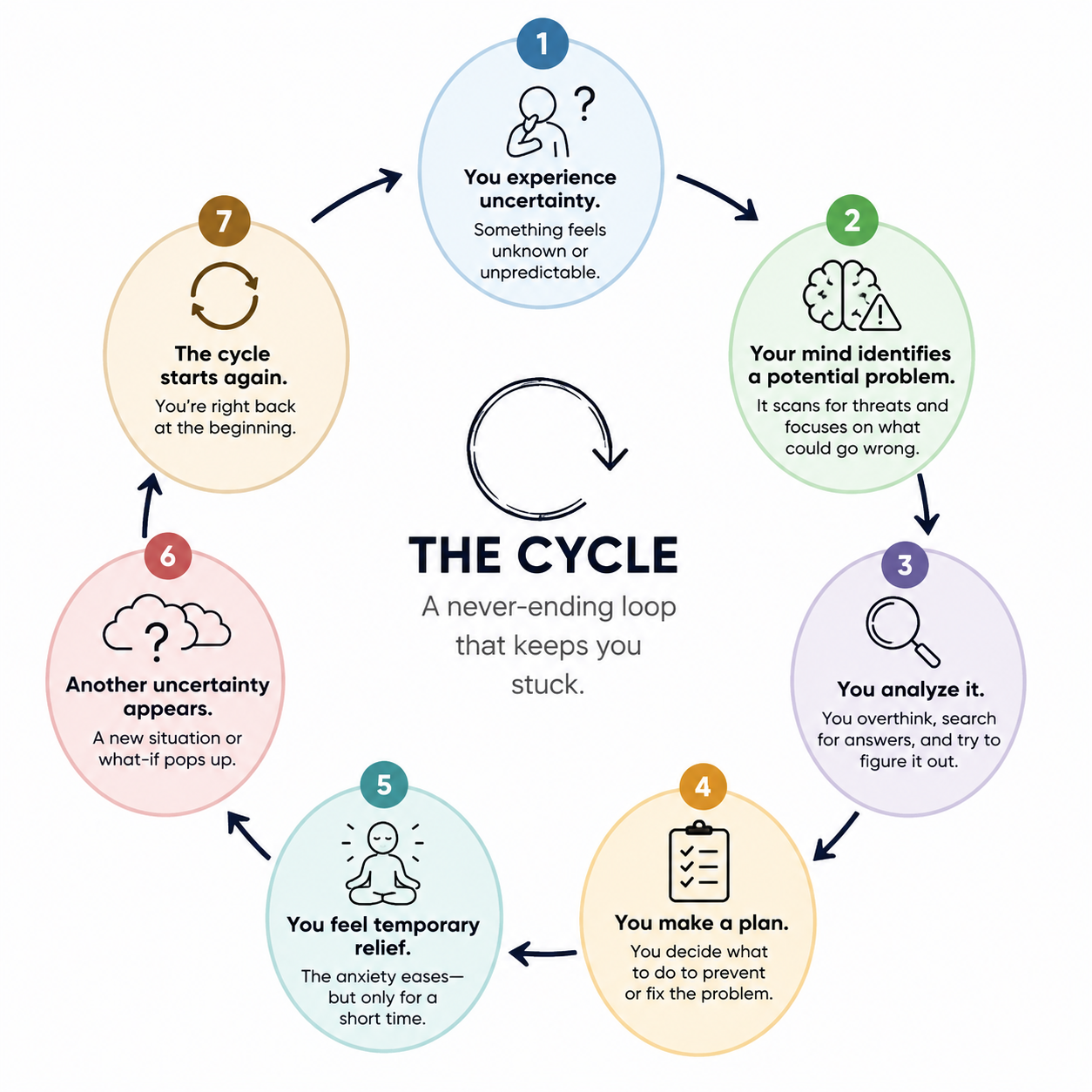
Over time, your brain can become accustomed to operating this way.
That's one reason simply telling yourself to "stop worrying" usually isn't enough.
Effective anxiety therapy isn't about eliminating every anxious thought. Anxiety is a normal human emotion, and some anxiety can even be useful.
Instead, therapy can help you develop a different relationship with anxiety—one that allows you to experience uncertainty without automatically responding with overthinking, perfectionism, avoidance, or excessive control.
How Anxiety Therapy Can Help
Working with an anxiety therapist can give you a place to slow down and understand what's happening beneath the constant pressure.
Depending on your individual needs, anxiety treatment may help you:
Identify the thoughts and behaviors that keep anxiety going
Recognize perfectionistic and overly demanding expectations
Develop healthier ways to respond to uncertainty
Reduce excessive worry and rumination
Become more comfortable setting boundaries and saying no
Understand the connection between thoughts, emotions, and behaviors
Practice self-compassion instead of constant self-criticism
Learn strategies for managing stress and emotional overwhelm
Become more comfortable resting without feeling guilty
Build greater flexibility when things don't go according to plan
Feel more present rather than constantly anticipating what's next
Therapy isn't about turning you into a different person or taking away the qualities that make you conscientious and capable.
It's about helping you keep the strengths while letting go of the anxiety-driven patterns that are exhausting you.
You Don't Have to Earn the Right to Feel Better
If you've spent years being the responsible one, the achiever, the problem-solver, or the person who always has it together, asking for help can feel surprisingly difficult.
You may think:
"Other people have it worse."
"I should be able to handle this."
"I'm functioning, so maybe it's not really a problem."
But functioning and feeling well aren't the same thing.
You can be successful and anxious.
You can be grateful for your life and still feel overwhelmed.
You can love your work and still be exhausted by the pressure you put on yourself.
And you can want things to change even when you can't point to one obvious thing that's "wrong."
You don't have to wait for anxiety to become unbearable before reaching out.
Finding the Right Anxiety Therapist
A good therapeutic relationship can make a meaningful difference. You want to feel comfortable being honest about the thoughts, fears, and pressures you may not share with anyone else.
At Fairfield Counseling Center, we work with individuals experiencing anxiety, perfectionism, chronic worry, stress, and the pressure to always have everything under control.
Therapy can be a place where you don't have to perform, achieve, or have all the answers. You can slow down, understand your patterns, and begin developing ways of living that feel more sustainable and authentic.
If anxiety has become the background noise of your life—even while everything looks fine from the outside—you don't have to manage it alone.
Ready to Feel Less Pressure and More at Ease?
If you're looking for anxiety therapy and want to explore whether working with an anxiety therapist could be helpful, we invite you to contact Fairfield Counseling Center.
Reach out to schedule a consultation and take the first step toward understanding your anxiety, easing the pressure, and creating more room to feel present and at peace in your life.